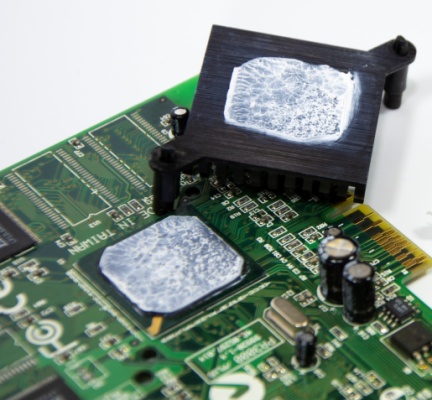
Printed Circuit Board (PCB) Thermal Interface Materials

Enhance device performance and extend operational life by efficiently dissipating heat with our range of Printed Circuit Board (PCB) Thermal Interface Materials.

Enhanced Thermal Performance

As components shrink and grow more complex, effective heat management is crucial for performance and reliability. Thermal interface materials (TIMs) optimize heat transfer and extend product life.

Thermal Management Application Shot

Advanced Thermal Solutions

Thermal Management Image
Enhanced Heat Transfer

Our TIMs are optimized to fill air gaps and ensure continuous heat flow, reducing thermal impedance and maintaining device stability in intense operating conditions.

Durability for High-Power Electronics

TIMs lower operating temperatures, extending the service life of high-power electronics and supporting long-term reliability in demanding applications.

Compact Design

Our TIMs are designed for modern, space-limited layouts, maximizing thermal performance without compromising device miniaturization or system complexity.

Customized Solutions

Our TIMs, available in gap pads, gels, thermal pastes, liquid gap fillers, and dielectric sheets, meet diverse thermal and assembly requirements.

Bond-Line Thickness

Our TIMs ensure optimal surface contact with consistent bond-line thickness, providing superior heat transfer, even in complex or uneven geometries.

Thermal Interface Materials

View our Brochure
Thermal_image_-_electrolube_487x300

Gap Filling Pads

Electrolube® Thermally Conductive Gap Filling pads range from 1.5W/m-K up to 8.5W/m-K thermal conductivity. These pads efficiently conduct heat away from your precious devices, thus ensuring a longer working lifetime and reduced risk of failure. 

The pads are available in both silicone and non-silicone formulations. 

With a thickness range of 0.5 up to 5mm (20 to 200 mil) and a soft, conformable structure, these pads are an ideal solution for creating an excellent thermal path.

Contact Us
gap-filling-pads

Thin Dielectric Sheets

Electrolube® Thin Dielectric Sheets provide an efficient thermal path when smaller gaps need to be filled and electrical isolation must be maintained. The materials have a reinforcement carrier to ensure easy handling, and when choosing a Polyimide reinforcement, an extended breakdown voltage can be achieved. Additionally, the material can also be provided with a strong adhesive on both sides, making the use of additional mechanical fasteners unnecessary. 

Contact Us
thin_delectric_sheet_0

Thermal Pastes

Electrolube® Thermal Pastes are one-component materials that do not require mixing or curing. These pastes create a highly efficient interface between the two mating surfaces thanks to their excellent wet-out properties. Combined with a fairly thin bond line thickness, these pastes offer very low thermal impedance, making them extremely suitable for high-power applications.

DISCOVER PRODUCTS
thermal_pastes_htc02s-3_0

Pre-Cured Gels

Electrolube® Pre-Cured Gels are one-part, form-in-place materials that do not require mixing or post-curing. Gels are more thixotropic than thermal pastes, enabling thicker bond lines and ensuring high vertical gap stability. Pre-Cured Gels can be manually dispensed or applied using automated systems.

Contact Us
pre-cured_gels

Liquid Gap Fillers

Electrolube® Liquid Gap Fillers are two-component, cure-in-place materials formulated for high-volume production. Dispensed easily through automated in-line equipment, they enable fast processing and operational efficiency. After curing, Liquid Gap Fillers provide a highly reliable solution, ensuring no risk of pump-out at the interface.

Contact Us
Liquid Gap Filler TIMs

Explore Categories

Liquid Gap Fillers

Advanced thermal management solutions that deliver efficient heat dissipation and long-term system reliability.

Learn More

Thermal Pastes

Address heat dissipation challenges with efficient heat transfer for optimal performance and reliable thermal management.

Learn More

Why MacDermid Alpha?

Integrated Solutions
Our integrated thermal management solutions optimize heat dissipation, improve thermal conductivity, and enhance long-term device reliability in high-power PCB assemblies. From thermal interface materials (TIMs) to advanced solder and polymer technologies, we reduce operating temperatures, prevent overheating, and extend product lifespan. Engineered for energy efficiency and sustainable electronics manufacturing, our solutions lower power consumption, support environmental compliance, and reduce total cost of ownership.

Sustainability
Our sustainable thermal management solutions improve heat dissipation while reducing energy consumption and extending electronics lifespan. By lowering operating temperatures and enhancing thermal efficiency, our materials help decrease power usage, minimize waste, and reduce carbon footprint across PCB assembly and high-power applications. Designed to support RoHS and REACH compliance, our portfolio enables environmentally responsible manufacturing without compromising performance, reliability, or total cost of ownership.

Reliability
Engineered for optimal performance, our advanced thermal management materials deliver reliable heat dissipation in high-power electronics, EV systems, data centers, and complex PCB assemblies. By reducing thermal resistance, controlling junction temperatures, and improving long-term stability under thermal cycling, our solutions enhance board-level reliability, prevent premature failures, and extend device lifespan. The result is consistent performance, lower warranty risk, and greater manufacturing confidence in demanding, mission-critical applications.

SS_tims

Frequently Asked Questions

Why is thermal management essential for high-power PCB assemblies and electronic systems?

Thermal management is critical in high-power electronics and PCB assemblies because excessive heat can degrade components, reduce performance, and ultimately lead to device failure or shortened lifespan. Efficient heat dissipation and thermal control maintain optimal junction temperatures, improve electrical performance, prevent thermal runaway, and reduce the risk of solder joint fatigue in high-density and high-current applications. Effective thermal management also supports energy efficiency, system reliability, and long-term durability in demanding environments such as automotive, power electronics, renewable energy, and data center systems. By mitigating thermal stress, manufacturers can achieve higher uptime, lower warranty costs, and improved end-product quality.

What should I consider when choosing thermal interface materials (TIMs) for efficient heat management?

When selecting thermal interface materials (TIMs) for PCB assemblies and high-power electronics, key factors include thermal conductivity, bondline thickness, surface wet-out, and interface stability under thermal cycling. Choose TIMs with high thermal conductivity to efficiently transfer heat away from components, and materials that maintain thin, uniform bondlines for low thermal resistance. Consider the operating environment, power density, device size, mechanical compliance, and long-term stability to ensure sustained performance in demanding applications such as automotive, industrial, and power electronics. Other important factors include ease of application, reworkability, and compatibility with surrounding materials to optimize assembly reliability, energy efficiency, and manufacturing yield.

How do thermal pastes improve heat transfer and device reliability in electronics cooling?

Thermal pastes improve heat transfer in electronic devices and PCB assemblies by filling microscopic air gaps and surface irregularities between mating surfaces, significantly reducing thermal resistance and enhancing thermal conductivity. This improved heat transfer helps maintain optimal operating temperatures, prevent overheating, and protect sensitive components from thermal stress. By promoting efficient junction-to-heat-sink conduction, thermal pastes support higher power density designs, improve system reliability, and extend service life in demanding applications such as automotive, power electronics, and industrial systems.

What are the benefits of dielectric sheets for PCB thermal management and electrical isolation?

Dielectric sheets offer key advantages in thermal management for high-density PCB assemblies and electronics cooling by combining electrical insulation with efficient heat dissipation. They prevent electrical shorts and leakage between conductive elements while enabling heat to transfer to heat sinks or thermal spreaders, making them ideal for compact, high-performance designs. Dielectric sheets also support easy reworkability and assembly flexibility, helping manufacturers maintain throughput and serviceability. These properties enhance overall device reliability, thermal performance, and manufacturing efficiency in demanding applications such as automotive, industrial, power electronics, and consumer systems.

What is the difference between thermal gap pads and thermal pastes in electronics cooling?

Gap pads and thermal pastes both improve heat dissipation in PCB thermal management, but serve different needs. Thermal pastes excel in thin bondlines by filling microscopic air gaps for maximum thermal conductivity. Gap pads are thicker and more compliant, ideal for larger or uneven gaps, offering easier assembly, vibration damping, and reliable thermal transfer in high-volume production. Both enhance device reliability, thermal performance, and electronics cooling efficiency.

Looking for Solutions? We can Help.

Contact Us

Learn More

Explore our Products

Learn More

View Resource Center

Learn More